The Great Togo trek - Lomé to Koutammakou
The time had come to finally explore Togo. Unlike many Nigerians who first visited on a primary school excursion years ago, I had never been. I boarded a bus from Mile 2 in Lagos that carried me west toward Badagry. From there, I joined a shared taxi that sped through Benin Republic before finally crossing into Togo at Lomé.
The plan was simple: drive across the country and see as much of Togo as possible, the cherry on top being the UNESCO World Heritage landscape of Koutammakou, home of the Batammariba people. Over the next 5 days, my guides and I would be on the road, somewhat of a serious trek, but big journeys unfold in segments, so we moved step by step.
Arrival in Lomé
We drove past endless kilometers of coastline, the smell of salt heavy in the air. It was going to be good for my mind and good for my body, I could feel it. My hosts, Dosse Via Trenou and Thomas Thompson, run a West African tourism company called Magic and Melanin. They provided the much appreciated soft landing as we caught up over a lovely homemade dinner. I would forever be grateful for their warmth.

Refreshed from a restful night, I woke up to the sound of young children at a nearby school while I got ready for the day. The days itinerary was to get a feel of the culture and also learn about the history of Togo. And so our first stop, the Palais De Lomé, which has been converted into a fantastic museum was a good idea. The structure, the gardens and the exhibition inside, everything is immaculate.

If you'd like to explore this part of the journey in more detail, read the full article here.
The Grand Marche d'Assigame in central Lomé was next on the itinerary and it is a major market for everything, from art souvenirs, to household items and fresh produce. As you can expect, high energy, bargaining and a constant sea of heads striking deals. The Sacred Heart cathedral of Lomé is an interesting structure that stands out here. It was built in 1902 by German colonial authorities and its quite magnificent.

Next for a some lunch, we went to La Plage (the beach). For a Nigerian, this felt like a luxury because almost all our beachfront in coastal Lagos is privately controlled. Here in Lomé, the beach belongs to everyone. I got an amazing lunch of fresh tilapia, french-fries and a side of tomatoes and onions. I paired that with an awooyol, their local beer and just let tension out. I also added a pedicure to the experience.

I was inspired by the quality of life in Southern Togo. The beauty in the details, particularly in the architecture is inspiring, and questions about how much teamwork it took to build it arose in my mind.

Into the Forest Plateau
The next day, we set out for Kpalimé, about 2 hours north of Lomé. It was interesting to see the landscape transform from coast to plateau. Togo is really well built, the roads, the houses, even the vendor stands, there seems to be an innate compass that points toward quality. As the car climbed into the hills, large trees rose to the sky, the undulating landscape adding drama and depth to the scene, it felt like a movie. The air is thick with humidity because it rains often here, perfect conditions for growing coffee and cocoa. We came to a small mountain cafe called Chez Paul for a taste.

If you'd like to explore this part of the journey in more detail, read the full article here.
Further up the mountain we visited Le Chateau Viale, another amazing piece of architecture that was built by a German colonial administrator named Viale in the 1900s. It was purchased by the government but it is now empty. The structure is marvelous, and I hope it can be developed into a tourist center that benefits both the locals and the government.
An artisanal center was next, an institution that empowers the artistic workforce of the area. Here, wood carvers, potters, painters, metal workers have space to create their artefacts. These are then sold in the central shop, and you can get good bargains for fantastic works of art.

We still had some time on the road, we had to get to Atakpame that night. So we stopped for a hot supper at a local canteen, and got back on the road. It had been raining for a while now and fluffy fufu and savory goat-meat soup was ideal in warming up our tired and cold bodies.

Romance in Atakpamé
Atakpamé was only a stopover town on this trek but we made some time to explore a bit the next morning. Before we got back on the road, we visited some locations to experience the wonderful views the town had. Our guide for this area, Kojo Tiwa, took us to see his neighborhood first. The town is quite hilly so lots of peaks and valleys, and plenty to see all around. It was a simple, clean and very charming. Kojo informed us that Atakpame is quite the lovers location, many couples come here for the romantic scenery. Someone was so inspired by the town’s landscape that he built a “Tower of Love” as a tribute to his wife, which we had to see. There are all kinds of flowers blooming in the beds as you climb, and the entire scene was cute and very picturesque.
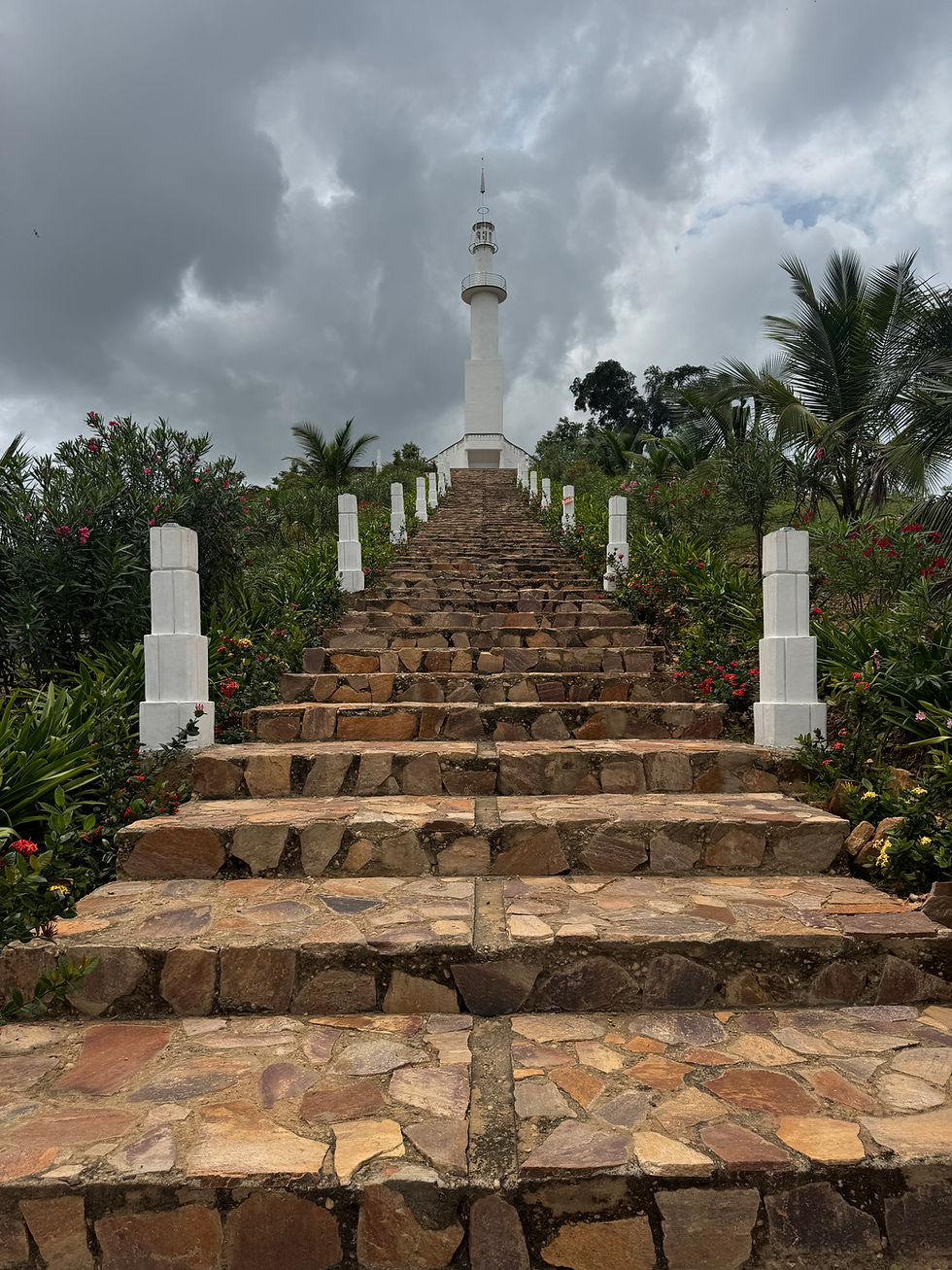
Kojo then took us to a personal project of his - an eco lodge (coming soon) with a small, natural waterfall and grove about a 10 minutes walk away. The water was so refreshing, the forest canopy calmed my soul and we overstayed here because it felt good to just be still and take a break from the road.

Toward the Batammariba Homeland
We had to force ourselves to leave because Kara, our next location was still 4 hours away. We spent the rest of the day on the highway and arrived Kara late in the evening. We found a canteen close to our hotel and I got this spaghetti in white sauce (made from mayonnaise), and topped with a fried egg.

Now it was just one more sleep between us and the ultimate objective, and although I was excited, my body needed the next 8 hours to reboot.
Getting into Kara was the first part of the trip that we experienced rough roads. They weren’t the worst I’d seen though, I live in Nigeria and as we drew closer to Koutammakou, my excitement mounted. This area is a UNESCO World Heritage Site and the people here are famous for how they build their homes. It was an amazing learning experience and you can read about that here.

Elephants and the Long Road Home
As if the interaction with the Batammariba wasn’t exciting enough, we left to visit a pair of young elephants at the Djamde national park. It was a magical interaction, to see these magnificent creatures glide across the fields looking for food felt magical. I had seen elephants before but never on African soil so this felt like quite the privilege. Read about that adventure here.

To say I was having one of the best days of my life is an understatement, all those kilometres had suddenly melted away and I felt really grateful. Now it was time to head back to Lomé for some rest and relaxation.
The digital artwork below is inspired by the richness of Northern Togo, and how the people live in close unity with the earth and the life around them.

Back in Lomé - Vodun and Nightlife
After returning to Lomé and getting some much needed rest, it was time to feel the energy of the capital. After a glimpse of the countryside, the contrast was very striking. The capital hums at a different pace, people moving through their daily routines as the buzz of vehicles filled the air.
Before we experienced the social energy however, it was important to feel the city spiritually. The best place for this is the famous Akodessewa Fetish Market, known locally as the Marché des Féticheurs. This is considered as one of the largest spiritual markets in West Africa and it is closely tied to the Vodun belief system - a significant part of the cultural life. Read about that here

Afterwards, it was time to feel the social energy. We left the market in order to get ready for the night. The itinerary was dinner, a lounge for pre drinks, and a club to end the night. It was my last dinner in beautiful Togo so once again I had to get some fresh tilapia and so we went to a charming restaurant called Chez Brovi and I had that with a side of fries and a vegetable side. For pre-drinks, we hit up a spot by the beach called Le Sunset lounge. Its a nice open air space with nice drinks and great music, so we caught a vibe. We were there a bit late for the sunset though, but I imagine it’s nice spot to watch the sun go down.


The night was still young so we left for a nightclub called Zanzibar and the interior of this place is impressive - lights, space and a well thought out layout that prioritizes human traffic. It's clear the designers thought about everything. This is where we wrapped up the very special final day in Togo.
Five days earlier I had set out from Lagos with a simple goal: cross Togo and see what the road reveals. What unfolded was far richer than expected. Across landscapes, from breezy coastline of Lomé to misty hills of Kpalimé and rocky plains of Koutammakou, each stretch revealed new layers of the country.
The long drives, local delicacies, deep forest treks, architectural marvels and smiling faces made every kilometer worthwhile. By the time I returned to Lome, the trek no longer felt like a checklist of destinations but like pockets of adventure unfolding across a map. Togo may be one of West Africa's smaller countries, but traveling its length showed me how much presence her and her people carry. Far larger than the borders would suggest.


Comments